Published: June 16, 2026 — Matches played June 15, 2026. Reviewed by Ask Bettsy Editorial Team
Key Takeaways
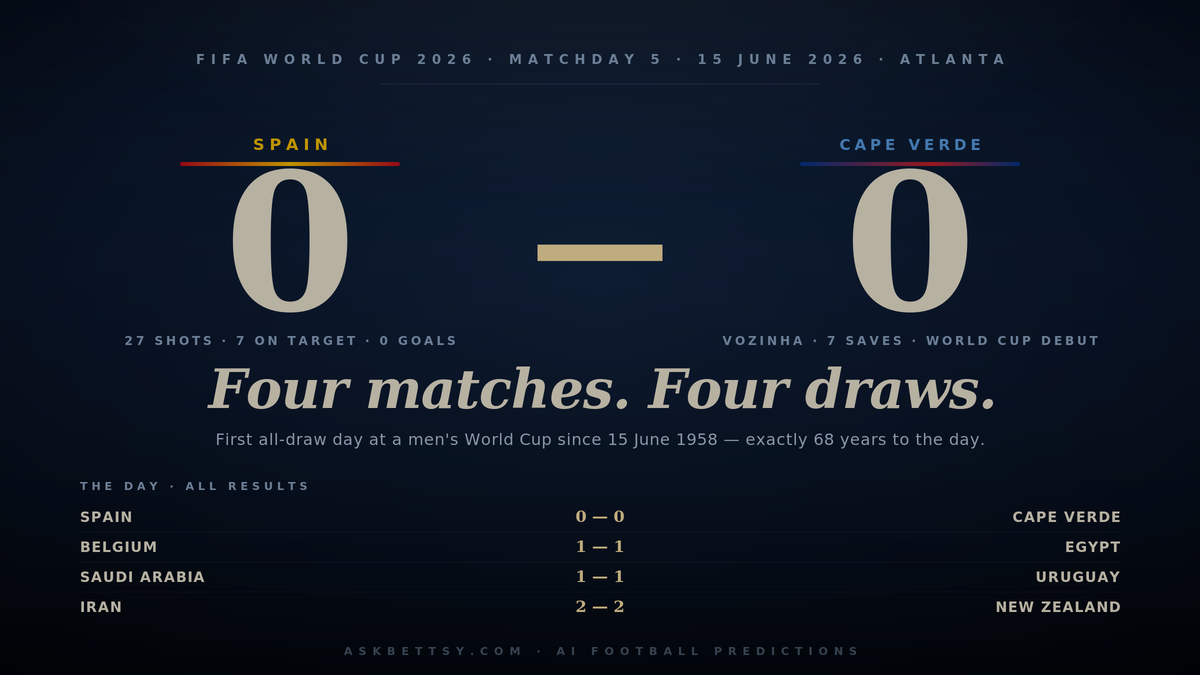
- World Cup debutants Cape Verde held European champions Spain to a 0-0 draw at Atlanta Stadium, surviving 27 Spain shots and an outstanding goalkeeping performance from 40-year-old Vozinha.
- All four matches played on 15 June 2026 ended in draws — the first time that has happened in a single day at a men's World Cup since 15 June 1958, exactly 68 years to the day.
- Spain remain the bookmakers' tournament favourite, but the price has drifted — the gap between their underlying chance creation and their finishing has now become the live narrative of Group H.
There are days at a World Cup where the tournament tilts. Monday, 15 June 2026 was one of them. Four matches were played across the United States. Four matches drew. The most quietly historic of them happened at Atlanta Stadium, where the world champions of Europe — Spain — generated 27 shots against a Cape Verde side that had never previously played a senior FIFA tournament match, and could not score one of them. The 0-0 was the headline. The 68-year-old World Cup record it equalled is the story underneath. Here is the Ask Bettsy football match analysis of what happened in Atlanta — and what it tells us about the rest of the tournament.
Cape Verde 0-0 Spain: the upset in the numbers
The match itself was a study in defensive composure. Spain dominated possession and territory. They generated 27 shots to Cape Verde's six. They had Aymeric Laporte breaking from the back line into midfield to add a second-phase passer. They had Lamine Yamal hugging the right touchline trying to draw Cape Verde's left-back out of position. The plan was sound. The finishing was not.
Of Spain's 27 attempts, only seven were on target. The single performance that defined the match came at the other end. Vozinha, the 40-year-old goalkeeper who arrived in Atlanta as the oldest player at the 2026 World Cup, produced a series of late first-half saves to deny Mikel Oyarzabal, Aymeric Laporte and Ferran Torres in quick succession. Each was the kind of stop that World Cup debutants do not normally make against European champions. Vozinha made all three.
Cape Verde manager Pedro Leitão Brito described the result as something that "means everything for our country", and praised his side's "organization and braveness". Both readings of the performance fit. This was not a Cape Verde side that arrived to defend with eight men behind the ball and hope to spring on counter-attacks. They held a mid-block, contested the second balls in midfield, and trusted Vozinha to handle the chances that broke through.
The lesson Spain will take is uncomfortable: 27 shots without a goal is not a finishing aberration when seven are on target. It is the underlying signal that the chances created were not high-quality enough. Spain's open-play xG against Cape Verde will sit closer to a draw-result than the 4-0 most pundits had projected pre-tournament.
The 1958 parallel: a 68-year record equalled
The Cape Verde-Spain result was the headline. The day's underlying story was bigger. Three other matches followed it on the schedule, and all three drew. Belgium 1-1 Egypt. Saudi Arabia 1-1 Uruguay. Iran 2-2 New Zealand.
Four matches in a single day at a men's World Cup had not all drawn since 15 June 1958. That tournament — held in Sweden — included a matchday on which Northern Ireland drew with West Germany, Argentina drew with Northern Ireland (in the same group), the Soviet Union drew with England, and Mexico drew with Wales. Football in 1958 was a 32-team tournament played without group-stage tactical analysts, video review or three substitutions. The fact that 2026 — with all of those tools, plus an expanded 48-team field and more depth across confederations than any tournament before it — has produced the same outcome on the same calendar date is the kind of coincidence that sport rarely arranges.
A 68-year record, equalled to the day. The format is different. The result is identical.
What the four draws actually tell you
Look beneath the coincidence and a clearer pattern emerges. Three of the four drawn matches involved a ranking gap of at least 30 places between the sides. In every case, the higher-ranked team out-shot the lower-ranked team by a meaningful margin and failed to convert the difference.
| Match | Result | Stat that decided it | |---|---|---| | Spain — Cape Verde | 0-0 | Spain 27 shots / 7 on target; Vozinha 7 saves | | Belgium — Egypt | 1-1 | Belgium converted first; Egypt levelled in the second half | | Saudi Arabia — Uruguay | 1-1 | South America's first dropped points of the tournament | | Iran — New Zealand | 2-2 | Two late goals tilted, and re-tilted, the result |
This is the pattern our dark-horse preview flagged two days before the tournament started: the 48-team format adds an extra knockout round, dilutes seeding advantage and rewards disciplined organisation. The 15 June fixture list was not an outlier. It was the first matchday on which the structural argument played out across every single result.
What this means for the favourites
Spain entered the World Cup as the bookmakers' shortest-priced contender at around +450 (9/2). The 0-0 result has not changed that they are still favourite, but it has materially changed the implied probability bookmakers place on a Spain trophy. The price has drifted toward +550 at most major sportsbooks since full-time, and the implied tournament-win chance has slipped from roughly 18% pre-tournament to closer to 15%.
For Group H, Spain still control their own qualification. They have Uzbekistan and Curaçao — both far weaker on paper — to play. But the path to winning the group outright has become tighter, and a second-place finish would push Spain into a Round of 32 fixture against a strong group winner instead of a more comfortable third-placed runner.
The wider read is the more interesting one. Belgium, Saudi Arabia's opposition Uruguay, and host of teams expected to roll through their openers all dropped points on the same day. The favourites at this tournament are dropping more points, earlier, against more disciplined opposition than at any World Cup in living memory.
Cape Verde — the story behind the story
The number that keeps coming back when you write about Cape Verde is the population. The country is home to fewer than 500,000 people. That makes them the third-smallest nation to ever play at a men's World Cup, behind only Iceland (2018) and Trinidad and Tobago (2006).
Cape Verde qualified via CAF, finishing top of a group that included Cameroon and Angola. They reached Atlanta on the back of a defensive system Pedro Leitão Brito has built around veteran spine — Vozinha in goal, organised central defending, and a midfield that contests rather than creates. The team is not built to win 4-0. It is built to win 1-0 or draw 0-0. Against Spain, the system worked exactly as designed.
If Cape Verde can hold a similar shape against Uzbekistan and Curaçao in their remaining group games, the AI prediction model now rates them at a 28% chance to qualify for the round of 32. That is a remarkable number for a World Cup debutant — and the kind of structural lift the 48-team format was supposed to produce for teams like this. So far, it is producing it.
Frequently Asked Questions
What was the score in Spain vs Cape Verde at the 2026 World Cup?
Spain and Cape Verde drew 0-0 at Atlanta Stadium on 15 June 2026 in their Group H opener. Spain registered 27 shots to Cape Verde's 6, but only 7 were on target. Cape Verde, making their World Cup debut, produced one of the largest ranking-gap shocks of the tournament so far by holding the European champions to a goalless draw.
How did Cape Verde hold Spain to a draw?
Cape Verde's draw against Spain was built on disciplined low-block defending and an outstanding goalkeeping performance from 40-year-old Vozinha, who made brilliant late first-half saves to deny Mikel Oyarzabal, Aymeric Laporte and Ferran Torres. Cape Verde absorbed 27 Spain shots and limited the European champions to only 7 on target across 90 minutes.
Who is Vozinha, the Cape Verde goalkeeper?
Vozinha is Cape Verde's 40-year-old goalkeeper and the senior figure of head coach Pedro Leitão Brito's squad. He delivered the defining individual performance of the 0-0 draw against Spain at the 2026 World Cup, making decisive saves in the closing stages of the first half to keep the European champions at bay.
Has there ever been four draws in a single World Cup day before?
Yes — once. The four draws on 15 June 2026 equalled a record set on 15 June 1958, exactly 68 years to the day. Until this matchday at the 2026 World Cup, no day of men's World Cup play had produced four draws since that 1958 fixture list.
Which matches drew at the World Cup on June 15, 2026?
All four matches played on 15 June 2026 ended level. Spain drew 0-0 with Cape Verde, Belgium drew 1-1 with Egypt, Saudi Arabia drew 1-1 with Uruguay, and Iran drew 2-2 with New Zealand. The combined result equalled the 1958 record for most draws in a single day at a men's World Cup.
Is Spain still favourite to win the 2026 World Cup?
Spain remain the bookmakers' pre-tournament favourite at around +450, but the price has drifted after their 0-0 opener against Cape Verde. With 27 shots producing zero goals and a meaningful gap between underlying chance creation and finishing, Spain's path to winning Group H is now narrower than expected. They still control their own qualification, but the implied trophy probability has come off the top tier.
Final Verdict
Spain v Cape Verde will be remembered for the score and for Vozinha. The day around it is the more important story. Five days in, the 2026 World Cup is already producing a structural pattern: the seeded favourites are dropping points, the underdogs are taking them, and the 48-team format is delivering the variance it was designed to deliver. Sixty-eight years to the day after the last such matchday in 1958, football quietly reminded everyone what a World Cup is for.
Get the AI verdict on every World Cup 2026 fixture: See today's match predictions.
All match data per FIFA official statistics and ESPN, as of June 16, 2026. Outright odds quoted are illustrative and subject to change. 18+. Gamble responsibly. Find support at BeGambleAware.org.