Last updated: September 7, 2026 — Reviewed by Ask Bettsy Editorial Team
Key Takeaways
- Most accumulators don't lose because of bad luck — they lose because of the math. Stacking legs multiplies risk faster than most bettors mentally price it in.
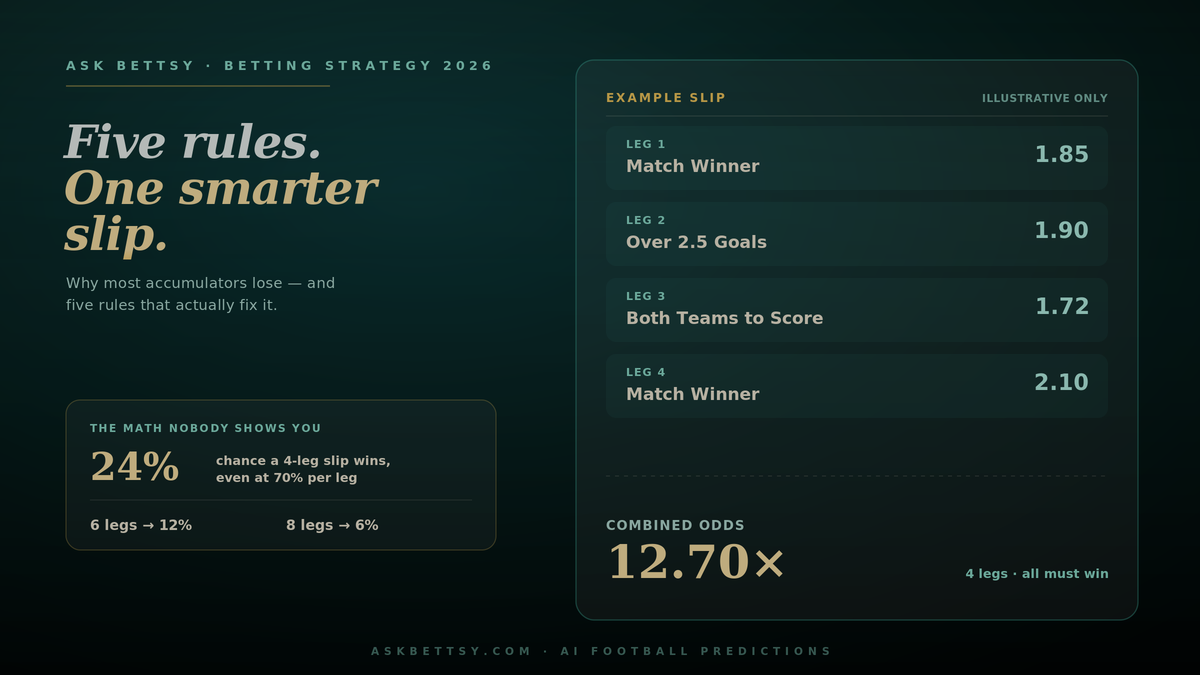
- A 4-leg slip where every leg is a genuine 70% shot still only wins outright about 24% of the time. That's arithmetic, not pessimism.
- Shorter, higher-conviction slips (2-4 legs) generally beat long shot-chasing slips (6+ legs) as a repeatable approach, not a one-off big win.
- Ask Bettsy's daily parlay is built from its highest-value predictions, not a random bundle — free users get one daily slip (8-12 combined odds), Premium users get a second, higher-odds slip (20-60 combined odds).
A parlay looks simple: pick a few matches, combine them, watch the odds climb. The appeal is obvious — a handful of "safe-looking" picks turning into a big number. The part that gets skipped is the math working against you with every leg you add, and it isn't subtle once you actually run the numbers. This is a practical guide to building accumulators that lose less often for reasons you can see coming, not a promise that parlays are a guaranteed way to win.
What a football accumulator actually is
An accumulator (also called a parlay) combines multiple individual bets — legs — into one slip. Every leg has to win for the accumulator to pay out. In exchange for that all-or-nothing structure, the odds multiply across legs, so five modest prices can combine into a number that looks like a jackpot.
That's also the entire risk profile in one sentence: one wrong leg loses the whole slip, regardless of how right you were on the other four.
Why most accumulators lose — the part nobody puts in the marketing
This is simple probability, and it's worth actually seeing written out. If every leg in your slip has a genuine 70% chance of winning — a solid, well-reasoned pick, not a coin flip — here's what happens as you add legs:
- 1 leg: 70% chance of winning
- 2 legs: 49% chance (0.7 × 0.7)
- 3 legs: 34% chance
- 4 legs: 24% chance
- 6 legs: 12% chance
- 8 legs: 6% chance
Nothing about any individual pick got worse. The slip's odds of paying out collapsed anyway, because probabilities compound. This is why an 8-leg accumulator with a huge headline price can still be a bad bet even when every single leg was a reasonable read on the match — you're not being wrong more often, you're asking more things to all be right at once.
None of this means accumulators are pointless. It means the size of the slip should match what you actually want from it: a realistic, repeatable approach, or a small-stake long shot you're treating as entertainment. Confusing the two is where most losses come from.
Five rules for building a smarter slip
1. Fewer legs, more discipline
What to check: how many legs are actually driving the combined odds, and would you back each one individually at those odds on its own?
Why it matters: every leg you add multiplies risk faster than intuition suggests. A 2-4 leg slip built from your most confident reads preserves a meaningfully higher win probability than a 6-plus-leg slip chasing a bigger number — and it's a strategy you can actually repeat week to week, rather than a one-off swing.
2. Watch for legs that aren't actually independent
What to check: are any two legs in your slip likely to move together — same match, same team, or outcomes that tend to happen as a pair (like "team wins" and "team's top scorer scores")?
Why it matters: standard accumulator odds assume each leg is roughly independent. When legs are correlated — especially multiple markets from the same match, i.e. a same-game parlay — the real combined probability doesn't match what the multiplied odds imply. That can work for or against you, but treat correlated slips as a different, higher-skill category, not a standard accumulator with extra steps.
3. Every leg needs its own value — not just the total
What to check: would you back this specific leg on its own, at its own odds, if it weren't part of a bigger slip?
Why it matters: it's easy to wave a weak leg through because "it's just one of six." A slip is only as good as its weakest leg, since any single leg failing loses the whole thing. If you wouldn't back a leg standalone, adding it to a parlay doesn't improve it — it just adds a way to lose.
4. Know what a free parlay is for versus a premium one
What to check: are you looking for a steadier, shorter-odds slip, or a bigger-swing, longer-odds one — and does the parlay you're using match that goal?
Why it matters: on Ask Bettsy, the free daily parlay and the Premium daily parlay are built for different jobs, not different quality tiers. The free slip sits in the 8-12 combined odds range — a shorter, steadier build. The Premium slip sits in the 20-60 combined odds range — a longer, higher-variance build aimed at bigger payouts. Using the wrong one for your actual goal (steady versus swing-for-the-fences) is a strategy mismatch, not a bad pick.
5. Track results — don't trust memory
What to check: do you actually know your accumulator record over the last month, or just the one big slip that hit?
Why it matters: parlays are memorable when they win and forgettable when they don't, which quietly distorts how good you think your strategy is. A bet tracker that logs every slip — wins, losses, and combined odds — is the only honest way to know if a 4-leg approach is actually beating an 8-leg approach for you, rather than relying on how the last few weeks felt.
How Ask Bettsy builds its daily parlay
Ask Bettsy's daily parlays are curated multi-leg slips built from the platform's highest-value predictions for that day, not a random bundle of fixtures. Free accounts get one daily parlay, typically in the 8-12 combined odds range. Premium accounts unlock a second, higher-odds daily parlay, typically in the 20-60 combined odds range, aimed at bigger payouts. Both are drawn from the same underlying AI football predictions — team performance signals, home/away form, squad and formation context, head-to-head history, and referee data — rather than a separate, lower-effort product.
Ask Bettsy is not a bookmaker and doesn't take the resulting bet — the daily parlay identifies the legs and the reasoning behind them; you place the bet with a licensed bookmaker of your choice.
DIY slip vs. a curated daily parlay
| | Building your own slip | Ask Bettsy's daily parlay | |---|---|---| | Leg selection | Manual — picks scattered across your own research | Curated from the platform's highest-value predictions for the day | | Data behind each leg | Varies by source, often inconsistent | Consistent structured data: stats, squads, form, referee context | | Correlation risk | Easy to miss without checking | Built to avoid obviously correlated legs within the same slip | | Tracking | Manual, easy to lose track of | Sits alongside the platform's prediction history for context | | Best for | Bettors who want full control over every leg | Bettors who want a data-led starting point without building it themselves |
Frequently Asked Questions
What is a football accumulator?
A football accumulator (or parlay) combines multiple individual bets, called legs, into a single bet slip. All legs must win for the accumulator to pay out. The appeal is that odds multiply across legs, turning a set of modest individual prices into a much larger combined price — but the risk multiplies with it, since a single losing leg loses the entire slip.
Why do most accumulators lose?
Mainly the math, not bad luck. If each leg in a slip has roughly a 70% chance of winning, a 4-leg accumulator's true chance of winning all four is about 24% (0.7 to the power of 4). Bettors who stack five or six legs for a big headline price are often accepting a genuinely low probability of any return, even when every individual leg is a reasonable bet on its own.
How many legs should a parlay have?
There's no universal number, but shorter accumulators (2 to 4 legs) preserve a meaningfully higher combined win probability than 6-plus-leg slips, while still multiplying odds. Bettors chasing very long shots with 7 or 8 legs should treat those as high-variance, small-stake entertainment bets rather than a core strategy.
What's the difference between a free and premium parlay?
On Ask Bettsy, free users get a daily curated parlay built from the platform's highest-value predictions, typically in the 8-12 combined odds range. Premium subscribers also get a second, higher-odds daily parlay aimed at bigger payouts, typically in the 20-60 combined odds range. Both are built from the same underlying prediction model, not separate products with different data quality.
Can Ask Bettsy build my parlay for me?
Ask Bettsy publishes a curated daily parlay built from its highest-value predictions rather than letting users assemble a fully custom slip inside the platform. Free accounts get one daily parlay; Premium accounts get an additional higher-odds daily parlay. Users still place any resulting bet with a licensed bookmaker, since Ask Bettsy is an analysis and prediction platform, not a bookmaker.
Is a same-game parlay a good idea?
Same-game parlays combine multiple markets from a single match, which often means the legs are correlated rather than independent, for example backing both a team to win and their top forward to score. That correlation can work for you or against you, but it means the headline odds don't reflect true independent probability the way a multi-match accumulator's odds roughly do. Treat same-game parlays as a distinct, higher-skill category rather than a standard accumulator.
Final verdict
Accumulators aren't a trick and they aren't a scam — they're a structure, and structures have math. Every leg you add multiplies the number on the ticket and divides your chance of collecting it. The five rules above don't turn parlays into a sure thing; nothing does. They just mean your slip loses for reasons you understood going in, not reasons you'd have seen coming if you'd done the arithmetic first. If you'd rather start from a curated slip than build one from scratch, today's Ask Bettsy daily parlay is built from the platform's highest-value predictions for the day.
18+. Gamble responsibly. No accumulator or prediction guarantees an outcome — sports results are uncertain by nature. Find support at BeGambleAware.org or see Ask Bettsy's responsible gambling resources.