Last updated: September 7, 2026 — Reviewed by Ask Bettsy Editorial Team
Key Takeaways
- "Powered by AI" is not an explanation. A genuine prediction model follows a specific, repeatable process — not a single mysterious step.
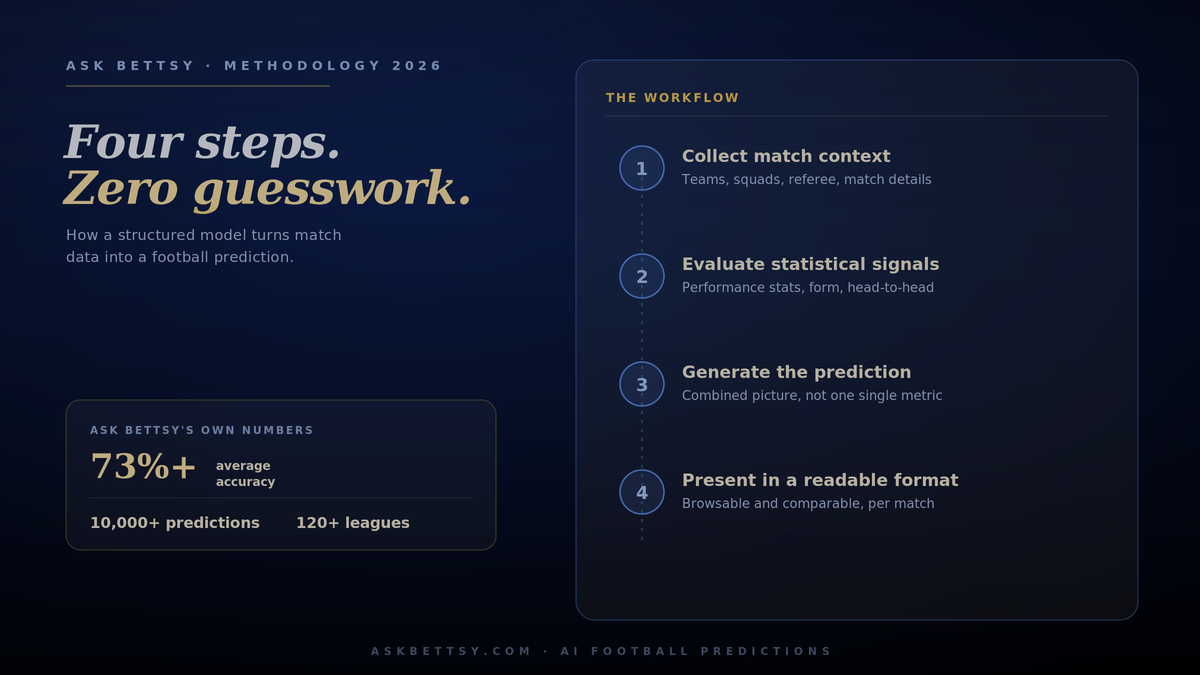
- The real workflow has four parts: collect context, evaluate signals, generate the prediction, present it clearly. Any platform that can't describe its version of this in plain language probably doesn't have one.
- A general AI chatbot and a structured prediction model are different tools solving different problems — one generates plausible text, the other evaluates structured match data.
- Ask Bettsy states its own numbers rather than vague claims: 73%+ average accuracy across 10,000+ predictions and 120+ leagues — and is explicit that no prediction guarantees a result.
Type "AI football predictions" into any search engine and you'll get dozens of sites making the same claim in slightly different words. Almost none of them explain what actually happens between "here's some match data" and "here's a prediction." That gap is where trust either gets earned or doesn't. This is a plain-English walkthrough of the actual mechanism — using Ask Bettsy's own published process as the concrete example — plus an honest look at where any model, however well built, runs out of road.
The short answer
A structured football prediction isn't one step — it's a pipeline. Data goes in, gets evaluated against specific football signals, gets combined into a prediction, and comes out the other end in a format you can actually read and compare across matches. Skip any one of those stages — especially the "structured data" part — and what you've got is a chatbot with a football skin, not a prediction model.
The 4-step workflow, in practice
Step 1: Collect match context
Before any prediction is generated, the model needs to know what it's predicting. That means gathering the teams, full squads, coaching setup, referee assignment, and other match-specific details for the fixture in question. This is the raw material — skipping or shortcutting this step is the single most common way a "prediction" ends up being closer to a guess.
Step 2: Evaluate statistical signals
With context in hand, the model evaluates performance indicators and structured match stats — the kind of signals a knowledgeable analyst would look at, applied consistently rather than cherry-picked per match. This is where team performance data, home/away splits, and other measurable patterns get weighed against each other.
Step 3: Generate predictions
The prediction itself is created from the combined picture of data and context — not a single metric in isolation, and not a generic language model guessing at a plausible-sounding score. This is the step that most separates a structured model from a chatbot: a chatbot predicts the next likely word; a prediction model evaluates the next likely outcome from structured inputs.
Step 4: Present in a readable format
A correct prediction that's unreadable or uncomparable isn't useful. The final step turns the model's output into something you can actually browse — a consistent structure across matches and leagues, so you can compare Saturday's ten fixtures on the same terms instead of reading ten differently-formatted paragraphs.
How Ask Bettsy handles this, specifically: this four-step structure — collect context, evaluate signals, generate predictions, present in a readable format — is Ask Bettsy's own published workflow, applied consistently across every covered fixture, and paired with a simple rating system so predictions can be prioritised rather than read as an undifferentiated wall of numbers.
Why this is different from asking ChatGPT
A general AI model — ChatGPT, Gemini, or any chatbot trained on open web content — can discuss football fluently, form coherent sentences about a match, and sound confident doing it. What it isn't built to do is consistently evaluate matches using structured inputs. It's predicting the next statistically likely words in a sentence, not running a model against squad data, referee history and form.
That's not a knock on general AI models — they're built for a different job. But "I asked an AI chatbot about the match" and "I used a structured prediction model" are two different processes wearing similar-sounding names, and conflating them is exactly what lets low-effort "AI tips" content pass as something more rigorous than it is.
What makes a prediction trustworthy — the numbers question
A four-step process is only as good as what it's measured against. A platform confident in its own model should state a real accuracy figure with real context, not an adjective. Ask Bettsy states 73%+ average accuracy across more than 10,000 predictions made and 120+ leagues covered — a specific, checkable number rather than "highly accurate" or "industry-leading."
Sample size matters here too: a claimed accuracy figure based on 50 predictions means something very different from one based on 10,000. Always ask what the number is actually measured against before trusting it.
What this process can't do
This is the part most "AI predictions" marketing skips, and it matters more than the workflow itself. No four-step process, however well-built, can:
- Account for events after the prediction is generated — a red card, an injury, a tactical substitution, or a refereeing decision mid-match sits outside any pre-match model.
- Eliminate the inherent uncertainty of football — even a well-supported 70% probability means the other outcome happens roughly three times in ten. That's not a flaw in the model; it's what a probability is.
- Guarantee an outcome — no legitimate platform should claim this. "Guaranteed wins," "risk-free bets," and "100% accurate" are marketing phrases, not statistical ones, and any site using them is telling you something about its honesty, not its model.
A trustworthy platform states this plainly rather than burying it. Ask Bettsy is explicit that no prediction guarantees an outcome, and that predictions are estimates based on available data and context — not certainties.
Structured model vs. generic AI chatbot
| | Generic AI chatbot | Structured prediction model | |---|---|---| | What it's built to do | Generate plausible, fluent text on any topic | Evaluate a specific match using structured data | | Input | Open web text and general knowledge | Team stats, squads, form, referee data, head-to-head | | Process | Predicts the next likely words | Evaluates the next likely outcome from structured signals | | Consistency across matches | Varies — depends on how the question is phrased | Same 4-step process applied to every covered fixture | | Stated accuracy figure | Rarely provided, hard to define | Should be a specific, checkable number |
Frequently Asked Questions
How do AI football predictions work?
A structured AI football prediction model typically follows four steps: collecting match context (teams, squads, coaching setup, referee, match details), evaluating statistical signals (performance indicators and structured match stats), generating a prediction from the combined data and context rather than a single metric, and presenting the result in a consistent, readable format. This differs from a general-purpose AI chatbot, which generates plausible-sounding text from open web content rather than running a model against structured match data.
What data goes into an AI football prediction?
A structured model draws on team performance signals and match stats, home versus away dynamics, squad and formation context, head-to-head history evaluated in context rather than as a raw record, and referee and match details. The specific combination and weighting varies by platform, but the presence of these structured, football-specific inputs is what distinguishes a genuine prediction model from generic AI text generation.
Is Ask Bettsy the same as asking ChatGPT about a match?
No. General AI models like ChatGPT or Gemini are trained on open web content and can discuss football fluently, but they are not built to consistently evaluate matches using structured data. Ask Bettsy is built around structured, professional sports data — player stats, expected goals (xG), referee history and odds — and follows a repeatable four-step workflow for each match, rather than generating a one-off plausible-sounding answer.
How accurate are AI football predictions?
Accuracy depends entirely on the quality and structure of the underlying data and should always be stated as a specific, checkable figure rather than a vague claim. Ask Bettsy states a 73%+ average accuracy across more than 10,000 predictions and 120+ leagues, and is explicit that no individual prediction guarantees an outcome — football results remain uncertain by nature.
Can an AI model guarantee a football result?
No. No AI model, however well-structured, can guarantee a sports outcome, because football results are inherently uncertain — injuries, refereeing decisions, weather and in-game variance all sit outside what any pre-match model can account for. A trustworthy platform will say this explicitly rather than implying certainty; treat marketing language like "guaranteed wins" or "100% accurate" as a red flag, not a selling point.
Does Ask Bettsy update predictions before kick-off?
Ask Bettsy's predictions are generated from match context and squad information as it becomes available, including updates when official lineup information is confirmed. Coverage and update timing depend on data availability for a given fixture, and the platform is transparent that predictions reflect the information available at the time they were generated.
Final verdict
"Powered by AI" tells you nothing about whether a prediction is worth trusting. The actual mechanism — collect context, evaluate signals, generate the prediction, present it clearly — is what separates a real model from a chatbot with a football skin, and any platform worth using should be able to walk you through its version of that process without hiding behind buzzwords. The honest ones will also tell you, clearly, what the process can't do. See the full workflow and today's predictions, or preview today's picks for free before deciding whether it's worth a closer look.
18+. Gamble responsibly. AI predictions are estimates, not guarantees — always bet within your means. Find support at BeGambleAware.org or see Ask Bettsy's responsible gambling resources.