Published: June 3, 2026 — Match played May 30, 2026. Reviewed by Ask Bettsy Editorial Team
Key Takeaways
- Paris Saint-Germain beat Arsenal 4-3 on penalties to win the 2026 UEFA Champions League final, becoming the first club since Real Madrid (2016-17) to win back-to-back European crowns.
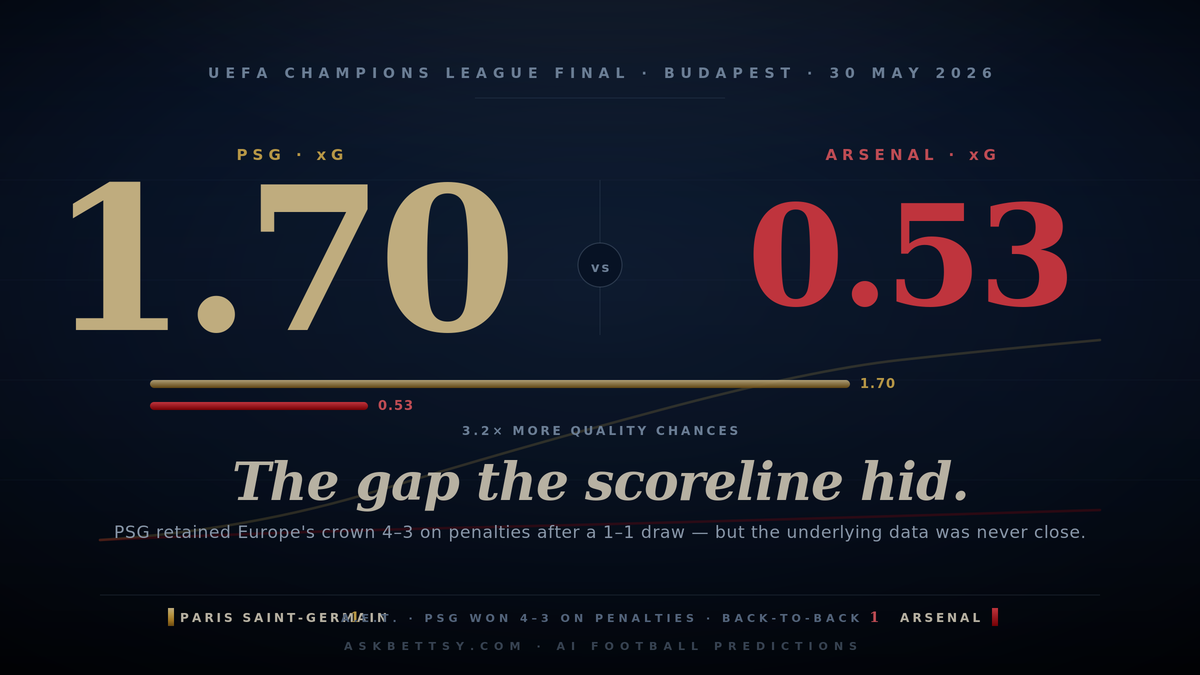
- PSG's underlying numbers were dominant — 1.70 xG to Arsenal's 0.53 — meaning the 1-1 scoreline flattered Mikel Arteta's side.
- Vitinha was the decisive tactical figure: 162 touches, 22 progressive carries and 671 metres of carry distance before being subbed at the 105-minute mark.
On Saturday night in Budapest, Paris Saint-Germain became only the second club in the Champions League era to win back-to-back European titles. The 1-1 draw and 4-3 penalty shootout victory over Arsenal at the Puskás Aréna will be remembered as a coin-toss final. The data tells a different story. PSG out-pressed, out-progressed and out-created Arsenal across 120 minutes, and only Mikel Arteta's organisation — plus a series of decisive Arsenal interventions in the box — kept the game close enough for spot kicks to decide it. Here is Ask Bettsy's data-driven football match analysis of how PSG won the 2026 Champions League final.
The xG verdict: 1.70 vs 0.53
The pre-match billing was simple: the best attack in Europe against the best defence. PSG arrived in Budapest on track to become the highest-scoring side of any Champions League era. Arsenal had conceded fewer than half a goal per game across the entire tournament. Something had to give. The numbers say PSG broke Arsenal's defence cleanly — the scoreline says it didn't quite cost them.
PSG generated 1.70 expected goals to Arsenal's 0.53 across the 120 minutes, according to the post-match underlying data. That gap of more than three to one is, in xG terms, a comfortable win on chance quality. Arsenal managed just one shot on target before the half-time whistle and 0.26 xG in that first 45. PSG sustained pressure, won territory, and forced David Raya into more meaningful saves than Matvey Safonov.
When an xG gap that wide produces a 1-1 result, two things have usually happened. First, the favoured side has wasted a high-leverage chance. Second, the underdog has scored against the run of play. Both were true at the Puskás Aréna. Khvicha Kvaratskhelia's 77th-minute strike onto Raya's post — diverted by a heroic Myles Lewis-Skelly block — would have been the goal that closed the game out. Six minutes earlier, on six minutes flat to be precise, Arsenal had already done their scoring against the run of play.
Kai Havertz's six-minute thunderbolt
Kai Havertz needed three touches with his left foot before unleashing the fourth into the roof of the net. Safonov was rooted to his spot, and Arsenal were 1-0 up in Europe's biggest game inside the first six minutes. It was the highest-stakes left-footed strike of Havertz's career, and it gave Arteta the platform he had spent the season building toward — a lead to defend with a fully-staffed back five.
The problem, as the underlying numbers later confirmed, was that Arsenal had no way to extend that lead. They were always going to need a second goal, and they didn't generate a chance worth more than 0.18 xG for the rest of regulation time. The lead became a target. The target became a siege.
The Vitinha effect: 162 touches, 22 progressive carries
If you want to understand why PSG won this match, you start with one player. Vitinha was named official UEFA Player of the Match for a reason that the casual viewer would miss without the data: the Portuguese midfielder ran the game from deep without ever needing to touch the ball in Arsenal's penalty area.
The numbers from his 105 minutes on the pitch tell the story. Vitinha recorded 162 touches — the most of any player on the pitch. He completed 141 passes. He received 127. He carried the ball on 133 occasions for a combined distance of 671 metres, and 22 of those carries were progressive — moving PSG meaningfully closer to Arsenal's goal. He attempted four shots, none on target, but that wasn't his job.
His job was to break Declan Rice. And he did. The pre-match tactical question had been whether Rice would sit deep enough to screen Arsenal's back four against PSG's elite midfield, or whether he would push high enough to deny Vitinha and João Neves time on the ball. Arteta picked the middle ground, and Vitinha found the space between Rice's first and second positions every time he received the ball. When Rice eventually adjusted, Neves found the space Rice vacated. That kind of compound problem is what separates one of Europe's best midfields from one of its better ones.
Where Arteta's plan broke down
Arsenal's plan was always going to be reactive. They had the best defensive record in the competition because they trusted Rice, William Saliba and Gabriel to absorb pressure and break out fast. The plan worked for 71 minutes after Havertz's opener. Then it didn't.
The breaking point was a sequence in the 77th minute when Kvaratskhelia got behind Lewis-Skelly and hit the post. Lewis-Skelly's recovery — an outstanding piece of defending — kept the score at 1-0 but signalled what was coming. The next time PSG attacked through the left, the foul came inside the box. Ousmane Dembélé converted from the spot. From that moment, Arsenal were chasing the game on a night when their xG had been pegged at half a goal.
The penalty shootout: who blinked first
The shootout itself was the most watchable part of a final that had run out of attacking ideas in extra time. Eberechi Eze dragged Arsenal's first spot kick wide of the post. David Raya saved from Nuno Mendes to keep things alive. At 3-3, Lucas Beraldo sent Raya the wrong way for PSG. Then Gabriel, with a chance to keep Arsenal in the final, blazed his effort over the bar.
There is no good way to lose a Champions League final on penalties. There is a worse way, which is to lose one in which the underlying numbers show you were dominated for 120 minutes anyway. Arteta will have his side back at this stage. The path to actually winning it requires more than a defensive masterclass and a Havertz thunderbolt — and the predicted lineups for next season's group stage will tell us how Arteta restructures his midfield in response.
Back-to-back: PSG's place in history
PSG are now the first club since Real Madrid's 2016-17 side to retain the Champions League. They are also the first French club ever to win the European Cup twice. In the post-Galáctico era of fragmented European competition — with squad rotation, financial fair play, and the expanded group stage — repeating as champion is harder than it has ever been. Luis Enrique's PSG project has now outproduced Pep Guardiola's Manchester City, Carlo Ancelotti's Real Madrid, and Mikel Arteta's Arsenal across a 24-month window.
That achievement deserves more credit than it has received in the days since, when the dominant narrative has been Arsenal's penalty heartbreak. It shouldn't. The 2026 final wasn't a near miss for Arsenal. It was a comprehensive tactical and statistical defeat that the scoreline obscured.
The reactions: Arteta in pain, Enrique "even stronger"
In the three days since the final whistle, both camps have given a clear sense of how they view what happened in Budapest — and where they go from here.
Luis Enrique's post-match line told you everything about how PSG view this title. "It's even stronger this year," the PSG manager said in his post-match interview. "We knew before the game how hard it is to play this Arsenal side. For us, as a team, as a city, it's incredible to win it and we deserve it for the way we've played throughout this season." He then offered an unusually candid concession that "neither team truly deserved to win" the final itself — a striking line from a winning manager, and one the xG data complicates given PSG's three-to-one advantage on chance quality.
For Mikel Arteta, the dominant emotion was simpler: "Pain." Speaking to the media after the shootout, the Arsenal manager praised Luis Enrique's side as "the best team in the world" and acknowledged PSG as "champions two times in a row." But Arteta was visibly furious about a 102nd-minute incident in which Nuno Mendes appeared to catch Noni Madueke in the box without a penalty being awarded. "I watch it back and it could easily be a penalty," Arteta told reporters — the kind of marginal officiating decision that, in a final this tight, becomes the difference between extra time and a winning spot kick.
His message to his players was warmer. "If I tell them one million times thank you it's not going to be enough," Arteta said, framing the season as one of growth rather than failure. The forward-looking statement was uncomplicated: Arsenal must be "very ambitious" — which most observers have read as code for the kind of midfield reinforcement this final exposed as a structural gap. PSG, meanwhile, have already shut down any exit rumours around Luis Enrique, with club president Nasser Al-Khelaïfi dismissing the speculation publicly. The manager who has now delivered back-to-back European Cups is staying in Paris.
What this means for 2026/27
The Champions League trophy now sits in Paris, and Vitinha — who looked exhausted as he came off in extra time — has the strongest argument for being the best central midfielder in Europe. Arsenal, for the second straight year, are the side that ran the Premier League hard and ran Europe harder still, only to come up short at the final hurdle. Ask Bettsy's models have already begun running the 2026/27 simulations. The early numbers suggest PSG are now genuine three-peat candidates — something only Real Madrid has done in the modern era. The question for Arteta is whether he doubles down on the defensive structure that got Arsenal here, or finally invests in the midfield runner who can compete with Vitinha for territory.
Frequently Asked Questions
Who won the 2026 Champions League final?
Paris Saint-Germain won the 2026 UEFA Champions League final, beating Arsenal 4-3 on penalties after a 1-1 draw at the Puskás Aréna in Budapest on 30 May 2026. It was PSG's second consecutive Champions League title, making them the first club since Real Madrid (2016-17) to win back-to-back European crowns.
Who scored in the 2026 Champions League final?
Kai Havertz scored for Arsenal in the sixth minute with a left-footed strike past PSG goalkeeper Matvey Safonov. Ousmane Dembélé equalised for PSG from the penalty spot in the second half. The 1-1 scoreline held through extra time, forcing a penalty shootout that PSG won 4-3.
Who was Man of the Match in the 2026 Champions League final?
Vitinha was named the official UEFA Player of the Match. The Portuguese midfielder recorded 162 touches, 141 completed passes, 22 progressive carries and 671 metres of total carry distance before being substituted at the 105-minute mark. His ball progression broke Arsenal's midfield press and tilted the pitch in PSG's favour throughout normal time.
Has any team won back-to-back Champions Leagues before PSG?
Real Madrid is the only other club to win back-to-back Champions League titles in the modern UEFA Champions League era, winning three consecutive trophies between 2016 and 2018. PSG's 2026 triumph following their 2025 victory makes them the second club to achieve a successful title defence, and the first French club to win the European Cup twice.
Where was the 2026 Champions League final played?
The 2026 UEFA Champions League final was played at the Puskás Aréna in Budapest, Hungary, on 30 May 2026, with kick-off at 18:00 CEST. It was the first time Hungary hosted the final of Europe's premier club competition.
What was the xG between PSG and Arsenal in the Champions League final?
PSG recorded 1.70 expected goals (xG) to Arsenal's 0.53 across 120 minutes of play. PSG out-shot Arsenal by a wide margin and restricted the English side to a single shot on target in the entire first half. The xG gap of more than three to one explains why the match was statistically far less even than the 1-1 scoreline suggests.
Final Verdict
PSG won the 2026 Champions League because they had the best midfielder on the pitch and the best tactical structure around him. Arsenal lost it because Havertz's six-minute thunderbolt set a target that their attack could not extend. The scoreline says it was a final on the edge of a coin flip. The xG says PSG had this one in control from the moment Kvaratskhelia hit the post. Luis Enrique now has a credible argument for the best European project of the decade. Mikel Arteta has the harder question: what does it take to win this trophy when defensive excellence is no longer enough.
See the model behind our analysis: Get today's AI-powered match predictions on Ask Bettsy and follow the 2026/27 season from the opening matchday. Live odds, AI predictions and tactical previews — all in one place at Ask Bettsy.