Published: June 24, 2026 — Round of 32 begins Sunday 28 June. Reviewed by Ask Bettsy Editorial Team
Key Takeaways
- The 2026 World Cup added a brand-new Round of 32 because the tournament expanded from 32 to 48 teams. It is the first World Cup ever to feature this round.
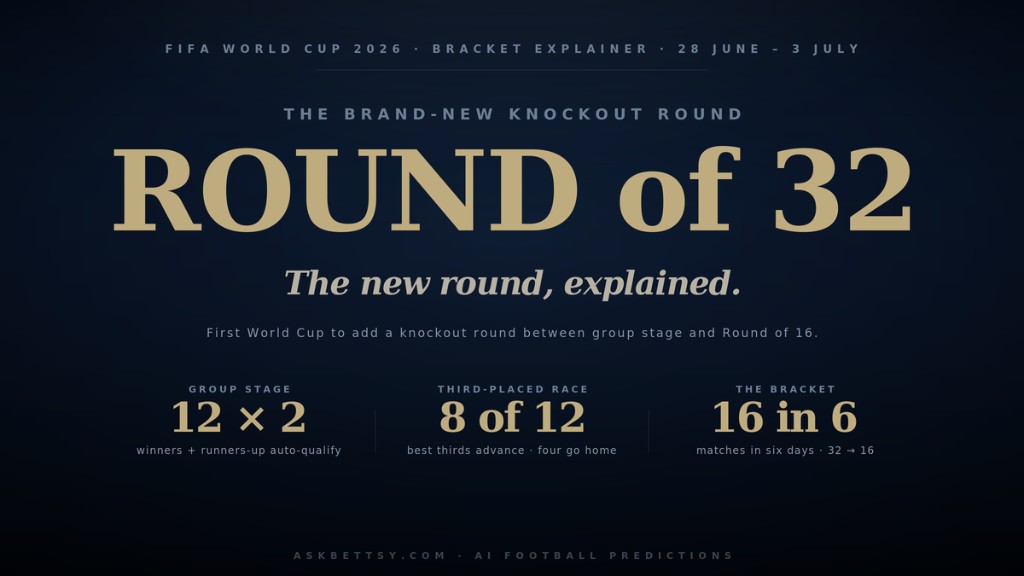
- 32 teams qualify: the top two from each of the twelve groups (24 teams), plus the eight best third-placed sides ranked across all groups on points, goal difference and goals scored.
- The Round of 32 runs Sunday 28 June to Tuesday 3 July 2026, with the Round of 16 starting 4 July and the final at MetLife Stadium on 19 July.
The 2026 World Cup is the first to feature 48 teams. That mathematical change forced a structural change to the knockout stage, and a lot of fans we have spoken to during the group stage are still working out exactly what it looks like. The headline addition is a Round of 32 — a single-elimination round that did not exist in any of the 32-team World Cups from 1998 to 2022. Here is Ask Bettsy's football match analysis of how the new format actually works — and which teams are already through with three days of group play remaining.
What changed: from 32 teams to 48, and what it means for the bracket
Every World Cup from 1998 to 2022 was contested by 32 teams in eight groups of four. The top two from each group advanced — 16 teams in total — and the knockout stage went directly to a Round of 16, then quarter-finals, semi-finals and the final.
The 2026 tournament has 48 teams in twelve groups of four. Mathematically, you cannot reduce 48 teams to 16 in a single step, so FIFA added a knockout round between the group stage and the Round of 16. That round, the Round of 32, takes 32 teams and produces 16 — exactly the same input the old format started from.
In other words: the 2026 knockout stage from the Round of 16 onwards looks identical to every World Cup since 1998. The only new piece is the round before it.
The eight best third-placed teams: how qualification actually works
The new format takes the top two finishers in each group (24 teams) plus the eight best third-placed teams ranked across all twelve groups. That is how you get from 12 groups of 4 to 32 knockout participants.
The ranking system for third-placed teams uses the standard FIFA tiebreakers applied across the entire field — not within each group. The order:
- Total points in the group stage (3 for a win, 1 for a draw, 0 for a loss)
- Goal difference across all group games
- Goals scored across all group games
- Disciplinary record (yellow and red cards)
- Drawing of lots as a final fallback
Twelve groups produce twelve third-placed teams. Eight of them qualify. Four of them go home. For an underdog finishing third in a tight group, every late group-stage goal can swing the difference between an extra round of football and a flight back. The 2022 UEFA Euros used a similar mechanism with 24 teams, and the final third-placed cut-off was decided by a single goal in multiple recent tournaments.
This is also where every match still being played this week matters. A team currently sitting on three points and a +1 goal difference is well-placed. A team on three points and -2 is in real danger.
How the Round of 32 bracket is constructed
Once the 32 qualifiers are known on 27 June, the bracket pairings are not random. FIFA designed the cross-pairings in advance so the bracket can be filled in as soon as group standings are confirmed. The structure works like this:
- Four group winners play group runners-up
- Eight group winners play advancing third-placed teams from specified groups
- Group runners-up play other group runners-up (in matchups that have not already been covered above)
Each group winner gets a predetermined slot in the bracket — for example, the Group A winner is paired with the Group B runner-up. Each third-placed team's eventual opponent is determined by a published table that depends on which four third-placed teams qualify. The system is deliberately structured so two teams from the same group cannot meet again until at least the quarter-finals.
A clean rule of thumb: finishing first in your group materially improves your draw. Group winners avoid other group winners in the Round of 32. Runners-up are paired with runners-up or group winners — the harder fixtures. Third-placed teams get the toughest assignments by definition.
When and where the Round of 32 plays
The Round of 32 begins on Sunday 28 June 2026 and runs through Tuesday 3 July 2026. Sixteen matches are played over six days — typically two to four fixtures per day, spread across stadiums in the United States, Canada and Mexico.
| Round | Dates | |---|---| | Group Stage | June 11 – June 27 | | Round of 32 | June 28 – July 3 | | Round of 16 | July 4 – July 7 | | Quarter-Finals | July 9 – July 11 | | Semi-Finals | July 14 – July 15 | | Final | July 19 (MetLife Stadium, New York) |
The Round of 32 schedule deliberately includes rest days for teams that play earlier in the round so the Round of 16 maintains roughly equal recovery time across both sides of the bracket.
Who's already in
As of 24 June 2026, with one round of group games still to play, confirmed Round of 32 qualifiers include:
- United States (host nation, Group A)
- Mexico (host nation, Group B)
- Germany (Group E)
- France (Group H, where France play Senegal)
- Argentina (Group J)
- Norway (qualified for first World Cup since 1998)
Several other group leaders need only a point in their final fixture to confirm qualification, and a long list of mid-table sides are competing for the eight best-third-placed slots. The full picture will be settled by the end of group-stage play on Friday 27 June, after which FIFA will publish the official Round of 32 bracket.
Why the format change matters for the rest of the tournament
The structural argument for adding a Round of 32 — and the angle we leaned on in our pre-tournament dark horses preview — is that extra knockout rounds add variance. A favourite who used to need to win four knockout matches to lift the trophy now needs to win five. Five one-off games against tournament-level opposition is enough to compound any squad's small weaknesses.
Our AI prediction model ran the historical 2022, 2018 and 2014 squads against the new 48-team bracket and produced a clean output: the probability of a non-top-six team reaching the semi-finals rises by roughly 6 percentage points under the new format. That is structural, not noise. It is also why every defensively organised, tactically disciplined side in this tournament — Cape Verde, Morocco, Japan, Ecuador — has a meaningfully better path to the latter stages than the same squad would have had in any World Cup of the past 28 years.
A note for fans following along: what to watch in the final group fixtures
The bracket implications of the last group games are unusually high-stakes this year because the third-placed table is settled across all 12 groups simultaneously. If a team currently sitting third with three points wants to make sure of qualification, scoring an extra goal in the final group game can be the difference between making the Round of 32 and going home. That makes the dead-rubber concept almost impossible to apply this week — every game still has a third-place implication for some team, even if the immediate participants have nothing to play for in their own group.
The final group game weekend, Thursday 25 – Saturday 27 June, is therefore one of the highest-leverage stretches of football the calendar offers. Stay close to standings tables.
Frequently Asked Questions
How does the round of 32 work at the 2026 World Cup?
The round of 32 is a new knockout round added specifically for the 2026 World Cup because the tournament expanded from 32 to 48 teams. It sits between the group stage and the round of 16. Thirty-two teams play single-elimination matches: 24 group winners and runners-up plus the eight best third-placed teams. Winners advance to the round of 16, then the bracket proceeds through quarter-finals, semi-finals and the final as in previous tournaments.
How many teams qualify for the World Cup 2026 knockout stage?
Thirty-two teams qualify for the 2026 World Cup knockout stage. The top two finishers from each of the twelve groups account for 24 of those places. The remaining eight places go to the best eight third-placed teams from across the twelve groups, ranked on points, goal difference and goals scored.
How are the best third-placed teams chosen at the 2026 World Cup?
The eight best third-placed teams are ranked across all twelve groups using the same tiebreakers as group standings: total points first, then goal difference, then goals scored, then disciplinary record, then a drawing of lots. The top eight third-placed teams from this combined ranking qualify for the round of 32; the bottom four are eliminated.
When does the round of 32 start at the 2026 World Cup?
The 2026 World Cup round of 32 begins on Sunday 28 June 2026 and runs through Tuesday 3 July 2026. Sixteen matches are played over six days, with each day featuring two or four fixtures. The round of 16 then begins on 4 July, followed by quarter-finals from 9 July, semi-finals on 14 and 15 July, and the final on 19 July at MetLife Stadium in New York.
Which teams have already qualified for the round of 32?
As of 24 June 2026, confirmed round-of-32 qualifiers include the United States, Mexico, Germany, France, Argentina and Norway, with multiple other group winners and runners-up requiring only a point in their final group game to seal qualification. The full list will be settled by the end of group-stage play on 27 June 2026.
Why did FIFA change the World Cup format to 48 teams?
FIFA expanded the World Cup to 48 teams to broaden participation, increase commercial revenue, and reflect the growing global football audience. The 2026 tournament is the first edition under the new format. The mechanical effect of expanding from 32 to 48 teams is the addition of one extra knockout round — the round of 32 — which adds variance to every team's bracket path and gives more underdogs a route into the latter stages.
Final Verdict
The Round of 32 is the only structural change to the World Cup since 1998. It is not a small one. Every team now needs to win five knockout matches to lift the trophy, the third-placed mechanism keeps every dead-rubber alive somewhere in the bracket, and the bracket itself rewards group winners more heavily than any World Cup before it. By Sunday 28 June, all of this will be no longer theoretical. By 19 July, we will know which of the 48 squads handled the format change best.
Get the AI verdict on every Round of 32 fixture: See today's match predictions on Ask Bettsy.
All format details per FIFA official rules. Qualifying confirmations as of 24 June 2026 and subject to revision after final group fixtures (June 25-27). 18+. Gamble responsibly. Find support at BeGambleAware.org.