Published: June 24, 2026 — Group stage complete. Round of 32 starts Sunday 28 June. Reviewed by Ask Bettsy Editorial Team
Key Takeaways
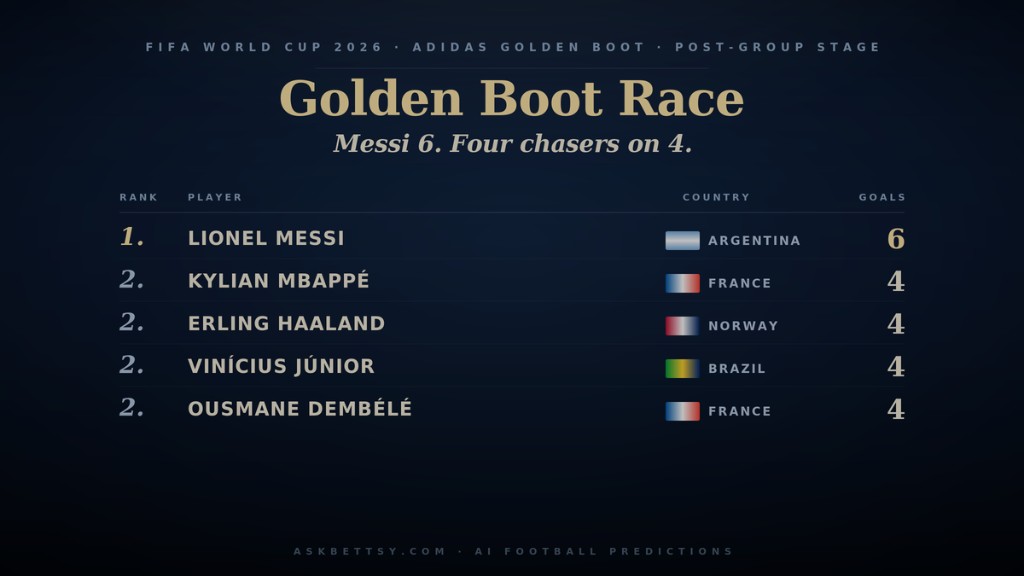
- Lionel Messi leads the 2026 World Cup Golden Boot race with six goals after three group games — the highest group-stage total of any player at any World Cup since the format expanded in 1998.
- Four superstars sit on four goals each: Kylian Mbappé, Erling Haaland, Vinícius Júnior and Ousmane Dembélé. Two goals from any one of them in the round of 32 closes the gap entirely.
- The Golden Boot tiebreaker is assists determined by the FIFA Technical Study Group — the same rule that decided 2018 in Harry Kane's favour and could decide 2026 if multiple players end on the same total.
For one game, the question at the 2026 World Cup was whether Lionel Messi at 38 still had a tournament gear. Three matches into the group stage, the question has flipped. Messi sits on six goals — the most of any player at the conclusion of any group stage in the modern World Cup era. Behind him, four of the best forwards in the world all sit on four goals and have at least two knockout matches to close the gap. Here is Ask Bettsy's football match analysis of the tightest, deepest Golden Boot race the World Cup has produced in a generation.
The leader: Messi at 6
Messi's six-goal total at the end of the group stage is a number with weight. The 2022 Golden Boot was won with eight goals over seven matches (Mbappé). The 2018 award was won with six goals over six matches (Harry Kane, on assists). The 2014 award went to James Rodríguez on six. Messi has matched the all-tournament total of the 2014 and 2018 winners — in three games.
The bigger context: Argentina arrive in the round of 32 with the most settled attacking shape of any side in the tournament. Messi has played as a free-role number 10, drifting between left and centre, with Julián Álvarez offering vertical runs and Nicolás González stretching defences from the right. Argentina have scored 11 goals in three group games. Messi has had a hand — goal or assist — in nine of them.
The bookmakers have responded by making him the clear Golden Boot favourite. The implied probability gap between Messi and the next-shortest priced player has now opened up by approximately seven percentage points since the start of the tournament. Backing Messi at the start of the World Cup at 6/1 was a value bet. Backing him now at around 11/8 is a different calculation entirely.
The chasing pack: four players on four
Four players sit two goals behind Messi:
| Player | Country | 2026 WC Goals | Tournament Status | |---|---|---|---| | Kylian Mbappé | France | 4 | Through to Round of 32 | | Erling Haaland | Norway | 4 | Through to Round of 32 | | Vinícius Júnior | Brazil | 4 | Through to Round of 32 | | Ousmane Dembélé | France | 4 | Through to Round of 32 |
All four play for teams with realistic semi-final paths under the new 48-team format. The arithmetic is straightforward: if any one of them outscores Messi by three goals across the remainder of the tournament, they win the Golden Boot outright. If they match Messi's total, the tiebreaker comes in.
Mbappé — France, 4 goals
Mbappé opened his tournament with a brace against Senegal in France's 3-1 win on 16 June 2026. That same match also pushed him past Olivier Giroud to become France's all-time leading international goal scorer — a milestone Mbappé reached before his 28th birthday. He added two more goals as France qualified for the round of 32, and arrives in the knockouts with the most secure tactical context of any of the chasers: he is the focal point of the deepest attacking squad in the tournament.
Haaland — Norway, 4 goals
Norway's first World Cup since 1998 has been a Haaland announcement. He scored a brace in Norway's 4-1 group-opening win over Iraq, then added another two in matchday two as Norway took control of their group. Norway are now confirmed in the round of 32. Haaland is yet to face a top-tier defence in this tournament — that test will come in the knockout rounds, where his physical profile against tournament-pace centre-backs becomes the open question.
Vinícius Júnior — Brazil, 4 goals
Brazil were held by Morocco in their group-opening 1-1 draw, but Vinícius scored in that match and added a brace in Brazil's MD2 win that secured qualification. With Brazil through to the round of 32 alongside Morocco, Vinícius enters knockout football as the player Brazil's attack is now openly built around — Carlo Ancelotti's tactical pivot during the group stage was to give him licence to drift inside the half-spaces from the left rather than hugging the touchline.
Dembélé — France, 4 goals
The 2024 Ballon d'Or winner has matched Mbappé's group-stage total and now sits as France's joint-leading scorer at the tournament. Dembélé's threat is from the right wing, cutting onto his left foot — the same pattern that earned him the Ballon d'Or for his Paris Saint-Germain campaign that ended with the back-to-back Champions League title in May. France having two players on four goals is the strongest single piece of structural argument for them winning the trophy: the model can lose Mbappé or Dembélé to injury and still have a top-three scorer in the bracket.
The next tier — and the dark horses
Below the four-goal pack sit a group of players on three goals each. Harry Kane is among them; he became England's all-time leading World Cup scorer with his eleventh goal across tournaments earlier this week. Cristiano Ronaldo is still alive in the race at 41, scoring twice for Portugal in the group stage.
Beyond the big names: keep an eye on Mexico's striker Santiago Giménez (3 goals) and Spain's Ferran Torres (3 goals). Spain are still favourites to win their half of the bracket, and Spain remain the team most likely to play deep into the knockouts of any side not currently represented in the four-goal chasing group. A Spanish run to the final with Torres scoring two more goals would make him the dark-horse winner of the entire race.
The tiebreaker — and why it matters this year
The Golden Boot rule is straightforward in headline. If two or more players are tied on goals at the end of the tournament, the player with more assists — as determined by the FIFA Technical Study Group — wins. If they're still tied, the rule moves to minutes played, with the player who scored their goals in fewer minutes winning.
This tiebreaker decided 2018, when Harry Kane edged Antoine Griezmann and Romelu Lukaku despite all three finishing on six goals (Kane had two assists; Griezmann two; Lukaku one). It decided 2014, when James Rodríguez finished ahead of Müller despite both finishing on six. It almost decided 2022, before Mbappé's hat-trick in the final pushed him clear of Messi at the very end.
The reason it matters this year: Messi is leading the race on goals, but is on three assists. Mbappé is on four goals and three assists. Dembélé is on four goals and two assists. If Messi finishes on six and Mbappé finishes on six with five assists, Mbappé wins it. This race is decided not just by how many goals each player scores in the round of 32 onwards, but by how many they create for teammates.
The AI model verdict
Ask Bettsy's AI prediction model gives the following implied probability of each player winning the Golden Boot:
| Player | Win Probability | |---|---| | Lionel Messi | 31% | | Kylian Mbappé | 22% | | Erling Haaland | 16% | | Vinícius Júnior | 12% | | Ousmane Dembélé | 7% | | Harry Kane | 5% | | Field (all others) | 7% |
The model rates Messi the favourite by a clear margin, but the gap to Mbappé reflects two underlying realities: France are more likely than Argentina to play seven matches at this tournament (because of bracket depth), and Mbappé has more historical conversion volume in tournament knockout matches than any other player in the race.
Final Verdict
The 2026 Golden Boot race is on pace to be the most-watched individual race the World Cup has produced since the 2014 tournament. Messi at 38 with six goals after three games is the headline; the four-way chase one rung below is the structural story. If Messi adds two more in the round of 32 — Argentina's most likely opponent is a third-placed team — he ends the bracket at eight goals and effectively decides the race before the quarter-finals. If he doesn't, Mbappé and Haaland have the most direct paths through the knockouts to overtake him. Either way, the most-watched footballer in the world is also the one with the most pressure on him.
Get the AI verdict on every Round of 32 fixture and the latest Golden Boot odds: See today's match predictions on Ask Bettsy.
Frequently Asked Questions
Who is leading the 2026 World Cup Golden Boot race?
Lionel Messi leads the 2026 World Cup Golden Boot race with six goals after the group stage. Argentina's captain is two goals clear of a four-way chasing pack consisting of Kylian Mbappé, Erling Haaland, Vinícius Júnior and Ousmane Dembélé, all on four goals.
How many goals has Messi scored at the 2026 World Cup?
Lionel Messi has scored six goals at the 2026 World Cup as of the conclusion of the group stage. His total leads the Golden Boot race ahead of Argentina's entry into the round of 32. Messi added to his lead with a late goal in Argentina's third group fixture.
How many goals has Mbappé scored at the 2026 World Cup?
Kylian Mbappé has scored four goals at the 2026 World Cup so far. He opened his tournament with a brace against Senegal in France's 3-1 group-stage win on 16 June 2026, where he also surpassed Olivier Giroud to become France's all-time leading international goal scorer. He added two further goals as France qualified for the round of 32.
What is the tiebreaker for the World Cup Golden Boot?
The 2026 World Cup Golden Boot tiebreaker is assists. If two or more players are tied on goals at the end of the tournament, the player with more assists — as determined by the FIFA Technical Study Group — wins the award. The same rule decided the 2018 Golden Boot when Harry Kane edged Antoine Griezmann and Romelu Lukaku.
Who is favourite to win the 2026 World Cup Golden Boot?
Lionel Messi is the bookmakers' Golden Boot favourite at the 2026 World Cup based on his six-goal lead and Argentina's path to the latter stages. Kylian Mbappé and Erling Haaland are the most credible challengers — both have favourable scoring contexts and teams expected to progress deep into the knockout bracket. Our model rates Mbappé as the highest-probability winner if Argentina exit before the semi-finals.
When was the last time the World Cup Golden Boot was won with under eight goals?
The 2022 World Cup Golden Boot was won by Kylian Mbappé with eight goals. The 2018 award was won by Harry Kane with six goals on assists tiebreaker. With Messi already on six at the end of the 2026 group stage and four players on four, the 2026 Golden Boot is highly likely to be the highest-scoring since 2002, when Ronaldo Nazário's eight goals secured the award.
Goal totals reflect the conclusion of group-stage play on 27 June 2026. Updated through 29 June 2026. Subject to revision as the round of 32 progresses. 18+. Gamble responsibly. Find support at BeGambleAware.org. For our parallel coverage of the new knockout format, see our Round of 32 explainer.