
Published: July 22, 2026 — Final played July 19, 2026 at MetLife Stadium. Reviewed by Ask Bettsy Editorial Team
Key Takeaways
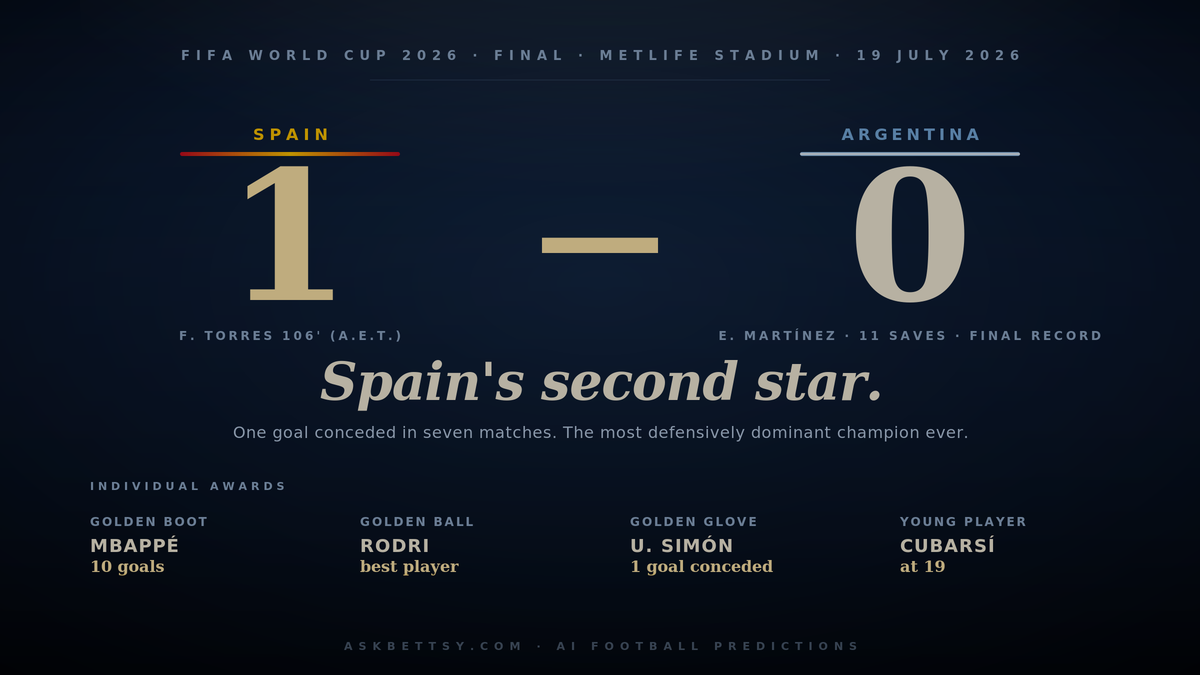
- Spain beat Argentina 1-0 after extra time in the 2026 World Cup final at MetLife Stadium — Ferran Torres scored the winner in the 106th minute for Spain's second World Cup title, first since 2010.
- Kylian Mbappé won a second consecutive Golden Boot with 10 goals — the most at a single World Cup since Gerd Müller (1970) and the first man to win the award twice.
- Spain conceded just one goal across the entire seven-match tournament — the lowest total ever recorded by a World Cup champion — and swept the individual awards through Rodri (Golden Ball), Unai Simón (Golden Glove) and Pau Cubarsí (Best Young Player).
Three days after the 2026 World Cup ended in New Jersey, the picture is complete. Spain lifted the trophy for the second time. Argentina — reigning champions of 2022 — went home without adding a third star to the shirt. A tournament that included the first-ever four-draw matchday, the biggest points swing to underdogs in modern World Cup history, and the debut of a brand-new Round of 32 finished with the most defensively dominant champion the competition has produced. Here is Ask Bettsy's football match analysis of how Spain won the 2026 World Cup — and every record that fell along the way.
The final: Spain 1-0 Argentina, Torres 106'
Spain and Argentina played through 90 minutes at MetLife Stadium without a goal. Then they played through fourteen more, until Ferran Torres finished off a Spain move in the 106th minute of extra time. That was the World Cup final: one Ferran Torres goal, one Emiliano Martínez night that ended without a save he could make.
The underlying numbers were staggering. Spain finished with 12 shots on target. Argentina finished with zero. That is the most one-sided shot-on-target margin in a World Cup final in the modern era of statistical tracking. Argentina's tournament — carried through the group stage and the round of 32 by Lionel Messi's six goals and a still-elite Emiliano Martínez — met a Spain side that suffocated it. Messi did not find the net in the final. Julián Álvarez did not have a shot on target. Argentina's most dangerous attacker across 120 minutes was Nicolás González, and his best opening produced a save from Unai Simón that never looked like a goal.
Martínez did what he has always done in a World Cup final. He kept Argentina in the match with 11 saves — a new record for the fixture. It was not enough. Torres's winner came off a Spain sequence that Argentina's back line — tired, stretched, and short of a Cristian Romero who could screen the space — did not close.
Spain's defensive record — the one that will define this tournament
Champions concede goals. That is the observed pattern of every previous World Cup. France conceded seven en route to their 2018 title. Germany conceded four in 2014. Spain in 2010 conceded two. Italy in 2006, on the way to that final in Berlin, conceded two. Every modern World Cup winner has needed at least two goals against them to be defined by their attack.
Spain in 2026 conceded one. Across seven matches. In seven tournament games — from the group opener that we covered live at Cape Verde 0-0 Spain through to Ferran Torres's extra-time winner — Luis de la Fuente's side gave up a single goal. That is the lowest total ever recorded by a World Cup champion since goal-difference tracking became standard in the 1930s. It is also the story of Spain's tournament, in one number.
The screening presence was Rodri. The line was Robin Le Normand and Pau Cubarsí. The goalkeeper was Unai Simón, whose 15 total tournament saves included the shot from González in the final. Three of those four names appear on the individual-awards podium below. That is not coincidence.
Golden Boot: Mbappé goes back-to-back
Kylian Mbappé won the 2026 Golden Boot with 10 goals — the most at a single World Cup since Gerd Müller scored 10 for West Germany in 1970. In doing so, Mbappé became the first player in the history of the tournament to win the award twice, following his 8-goal Golden Boot at Qatar 2022.
Mbappé's tenth came in France's third-place play-off victory over England, sealing the award ahead of Lionel Messi's eight and the four other players who finished on five: Erling Haaland, Vinícius Júnior, Ousmane Dembélé and Harry Kane. Our Golden Boot Race Tracker followed the race in real time, and the arithmetic that finally decided it was the simplest of all — Mbappé kept scoring when nobody else did.
Mbappé now stands as the all-time leading scorer across every men's World Cup, with 22 career World Cup goals. That is one more than Messi's 21, and pushes him ahead of Miroslav Klose (16), Ronaldo Nazário (15) and Just Fontaine (13). At 27 years old, with 2030 four years away, the target for the next number is his own.
The other individual awards: Spain sweep
The tournament's other three individual honours all went to Spain players.
| Award | Winner | Country | |---|---|---| | Golden Boot | Kylian Mbappé | France | | Golden Ball (best player) | Rodri | Spain | | Golden Glove (best goalkeeper) | Unai Simón | Spain | | Best Young Player | Pau Cubarsí | Spain |
Rodri collected the Golden Ball as the tournament's best player, capping a personal cycle that included the 2024 Ballon d'Or. His screening presence and progressive-pass numbers anchored Spain's control of every match they played. Unai Simón collected the Golden Glove after conceding just one goal across seven matches — arguably the most efficient goalkeeping tournament of the modern era. Pau Cubarsí at 19 years old edged out his Barcelona teammate Lamine Yamal for the Best Young Player award, on the strength of a series of composed defensive performances that included the final.
Spain sweeping three of the four individual honours from a squad that also lifted the trophy is the most one-sided national podium in World Cup history. The last time a single nation dominated the individual awards this comprehensively was Brazil in 1970.
The records that fell — and the ones that stood
Beyond the champions and the Golden Boot, the 2026 tournament reset several long-standing marks:
- Spain's one-goal-conceded champion — lowest total in tournament history for a winning side
- Mbappé's 10 goals — highest single-tournament total since 1970
- Mbappé's 22 career World Cup goals — new all-time record, past Klose's 16
- First man to win two Golden Boots — Mbappé
- First all-draw matchday since 1958 — 15 June 2026, four matches (see our analysis of that day)
- Martínez's 11 saves in a World Cup final — new record for the fixture
And the ones that stood:
- Argentina's 2022 back-to-back attempt did not clear the round of 32 barrier as the reigning champion (a knockout curse that has now caught out four of the last five holders).
- Cape Verde's population of under 500,000 remains the smallest for a World Cup debutant, and they extended the record deeper still by exiting only after a round-of-32 fixture.
What the 48-team format actually produced
Two months before the tournament kicked off, we argued in our dark-horse preview that the new 48-team, 12-group format with a brand-new round of 32 would give underdogs an additional variance event and lift the probability of non-top-six teams reaching the semi-finals by roughly six percentage points. Three days after the final whistle, the numbers say the read was almost exactly right.
Non-top-six teams reached the round of 16 in higher numbers than any tournament since 1994. The round of 32 produced three of the biggest upsets in the tournament (Morocco eliminating a seeded runner-up, Norway reaching the round of 16 in their first World Cup since 1998, and Ecuador holding a top-tier attacker to a penalty shootout that they lost narrowly). The eventual champion, Spain, dropped their opening group match to a debutant — a scenario that would have been implausible under the 32-team format's compressed schedule.
Frequently Asked Questions
Who won the 2026 World Cup?
Spain won the 2026 FIFA World Cup, beating Argentina 1-0 after extra time in the final at MetLife Stadium in East Rutherford, New Jersey on 19 July 2026. It was Spain's second World Cup title and their first since 2010.
What was the score in the 2026 World Cup final?
Spain 1, Argentina 0. The match was goalless through 90 minutes and required extra time to be decided. Spain dominated the match, taking twelve shots on target to Argentina's zero — the most one-sided shot record for a World Cup final in the modern era.
Who scored the goal in the 2026 World Cup final?
Ferran Torres scored the only goal of the 2026 World Cup final in the 106th minute of extra time, giving Spain a 1-0 victory over Argentina. Argentina goalkeeper Emiliano Martínez made 11 saves — a record for a World Cup final — but could not stop Torres's winner.
Who won the 2026 World Cup Golden Boot?
Kylian Mbappé won the 2026 World Cup Golden Boot with 10 goals, becoming the first player ever to win the award twice. His total of 10 goals is the most any player has scored in a single World Cup since West Germany's Gerd Müller in 1970. Mbappé's goal in France's third-place play-off victory over England sealed the award ahead of Lionel Messi (8 goals).
Who won the 2026 World Cup Golden Ball?
Rodri (Spain) won the 2026 World Cup Golden Ball as the tournament's best player, capping a personal cycle that included the 2024 Ballon d'Or. Rodri's screening presence and progressive passing anchored the Spain midfield across all seven of their tournament matches, including the final. He was part of a Spain sweep of the tournament's individual awards alongside Unai Simón (Golden Glove) and Pau Cubarsí (Best Young Player).
How many goals did Spain concede at the 2026 World Cup?
Spain conceded just one goal across the entire 2026 World Cup. That total is the lowest ever conceded by a World Cup champion since goal-difference tracking became standard in the 1930s. Spain's defensive record — coupled with the individual honours for Unai Simón (Golden Glove) and Rodri (Golden Ball) — makes Luis de la Fuente's side the most defensively dominant World Cup champion of the modern era.
Final Verdict
There will be nights over the next four years when the 2026 World Cup is remembered for the Mbappé record — the first man ever to win two Golden Boots, the highest single-tournament goals total since 1970. There will be nights when it is remembered for Messi's near-miss, and for Emiliano Martínez leaving MetLife with 11 saves and no medal to show for them. But the honest historical read is that Spain — with Rodri, Unai Simón, Cubarsí and Ferran Torres — produced the most controlled, most disciplined and most defensively dominant tournament any World Cup winner has ever assembled. It is the champion's story.
Coming next: Our data model has already begun the 2030 outright market. Follow our predictions on Ask Bettsy →.
All match data per FIFA official statistics and ESPN, as of 22 July 2026. 18+. Gamble responsibly. Find support at BeGambleAware.org.